


I spent a fair portion of my career treating fevers, so it seems reasonable to spend the next couple of weeks on the febrile illness caused by a four-yearly event: the men’s football World Cup.
Sports medicine is the only healthcare on display at a World Cup, a medical team sitting in the dugout or running onto the pitch when a player stays down, It is the best-resourced care those players will ever receive, and arguably the least important in any of their lives.
Every player at this tournament got there through decades of mundane healthcare: the midwife at the birth, the childhood immunisations, the nurse who cleaned and dressed the ten-year-old’s cut knee, the physiotherapy after the first serious injury at seventeen.
Having made a career looking at health systems and nursing, I wanted to see how those systems would fare in a tournament of their own. Forty-eight countries have just been put on a level(ish) pitch. How do they match up in the healthcare World Cup?
There are a thousand ways to run this exercise. I am going to start with two numbers: health spending per person and life expectancy.
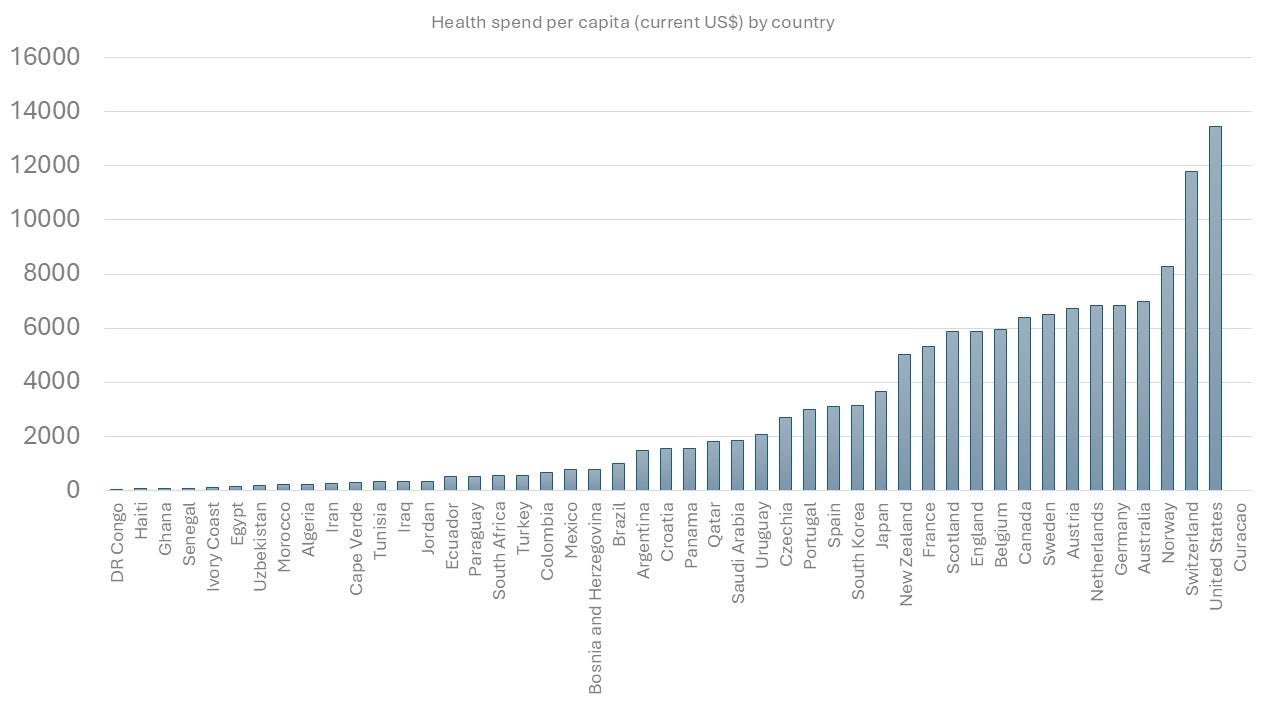
World Bank data 2023
Please note Curaco didn’t submit data and England and Scotland Data presented as UK
Line up the 48 teams by what their countries spend on health per person and you get a very different set of winners and losers. The United States sits at the top: $13,473 per person in 2023. The Democratic Republic of Congo sits at the bottom: $23 for a year of healthcare per person.
That is a 586-fold difference.
Two caveats: These are current US dollars, unadjusted for purchasing power. A dollar buys more nursing time in Kinshasa than in Boston, so the real gap is smaller but not 586 times smaller.
They are also national averages, which is its own distortion. The Congolese figure averages Kinshasa with the rural provinces, and averages in countries like the DRC conceal enormous variation, almost always in the same direction.
Money doesn’t automatically buy years.
Money is not the only thing that matters, and the teams at this year’s tournament prove it.
Female life expectancy in the United States is 81.4 years. South Korea, spending $3,137 per person, under a quarter of the American figure, reaches 86.6. Switzerland spends $11,784 and reaches 86.2. Korea buys five more years of female life than the United States at a fraction of the cost; Switzerland spends nearly everything the Americans do to arrive at roughly the Korean result. Spending is associated with outcomes, but it is not as simple as more money gets you more years on earth.
Why not? Because what the money buys is a system, and we make choices as to who is covered, where the staff go, what gets done early cheaply in primary care rather than expensively late in tertiary hospitals.
Morocco has proved really effective both on the pitch and off it. Women in Morocco live to 77.8, within four years of the United States, on a fiftieth of the spend. Algeria gets its men to 75.1 on almost the same budget.
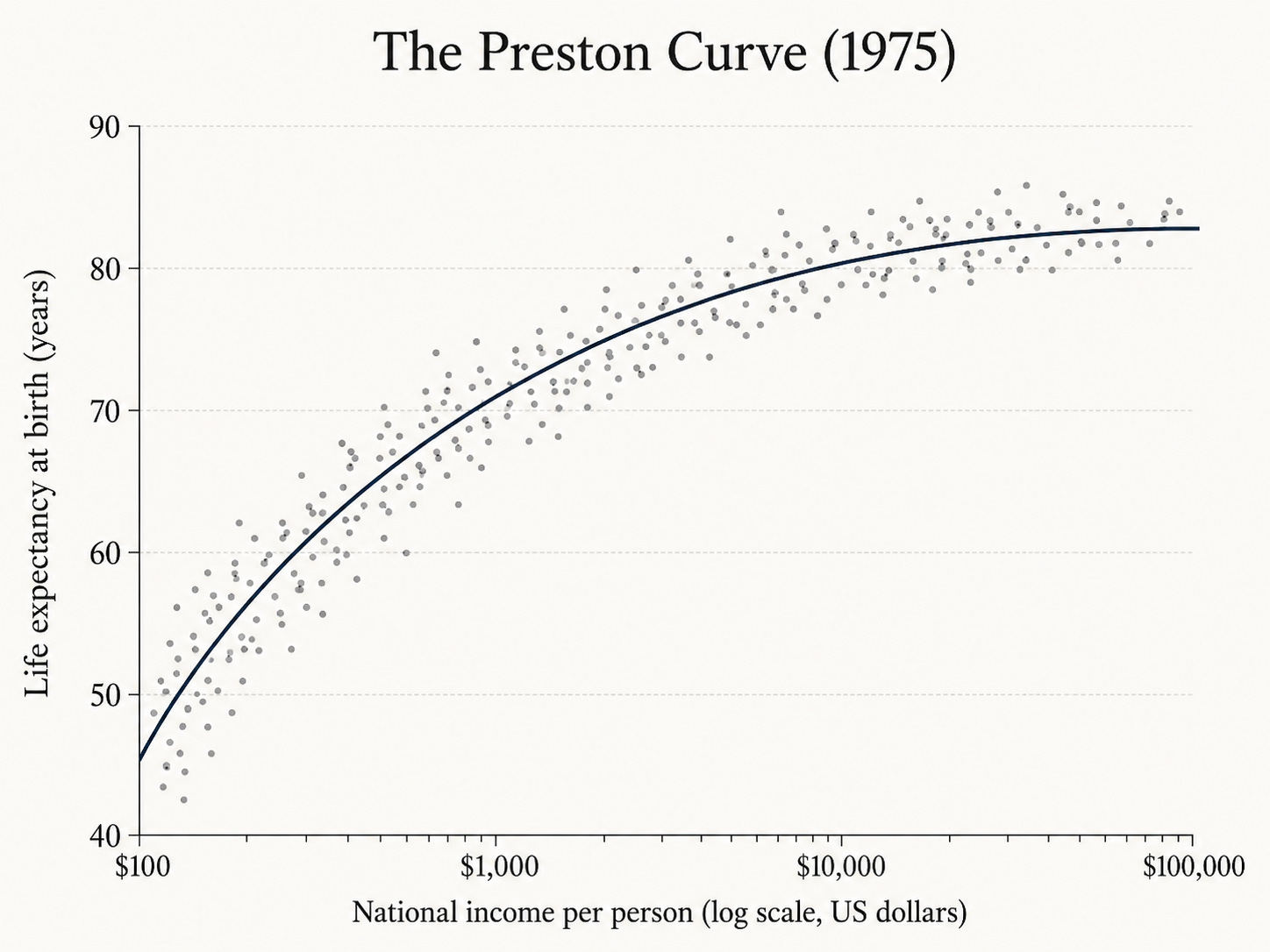
The first hundred dollars per person buys immunisation, an educated health worker at birth, and antibiotics for a child’s pneumonia. The last five thousand buys weeks, mostly at the end.
This is why the DRC’s $23 is a catastrophe and much of the USA’s $13,473 is inefficient and wasteful.
Congo healthcare means every dollar withheld (either through government spending or aid cuts) costs years. The United States is not just far along the curve, it’s falling below it. Some of the cause is price: an American hospital pays more than a Swiss one for the same scan, the same ICU bed, the same hour of agency nursing.
Some is administration as a system organised around billing, employing a vast army of people to do all that comes with chasing people for payment around an event of illness.
Korea and Switzerland sit above the curve for really important reasons: everyone is covered, primary care is dense, and disease is identified while it is still cheap to treat.
Morocco is on track: 99 per cent of its infants get their third diphtheria-tetanus-pertussis dose, and have done so for more than a decade . Eighty-seven per cent of births are attended by skilled staff, up from around two-thirds in the early 2000s.
Its entire health ministry budget for Morocco 2025 was about $2.5 billion: less than the annual turnover of Guy’s and St Thomas’
That is one London hospital trust.
The work that buys years cheaply is done by nurses, midwives and community health workers: the inexpensive end of the workforce, in every system, on every continent.
World Cups and health system performance may differ in many ways, but there are certainly winners and losers.
Related reading: The world’s next nursing shortage may not be where you think and What eleven specialists can do if they move around.