

I wanted to write this week about failure, and about why a programme I led and developed did not work. One of my major criticisms of the sector I work in is its ability to adopt the brace position every time even mild criticism appears. That habit limits our ability to learn from things that did not go well.
So, here goes.
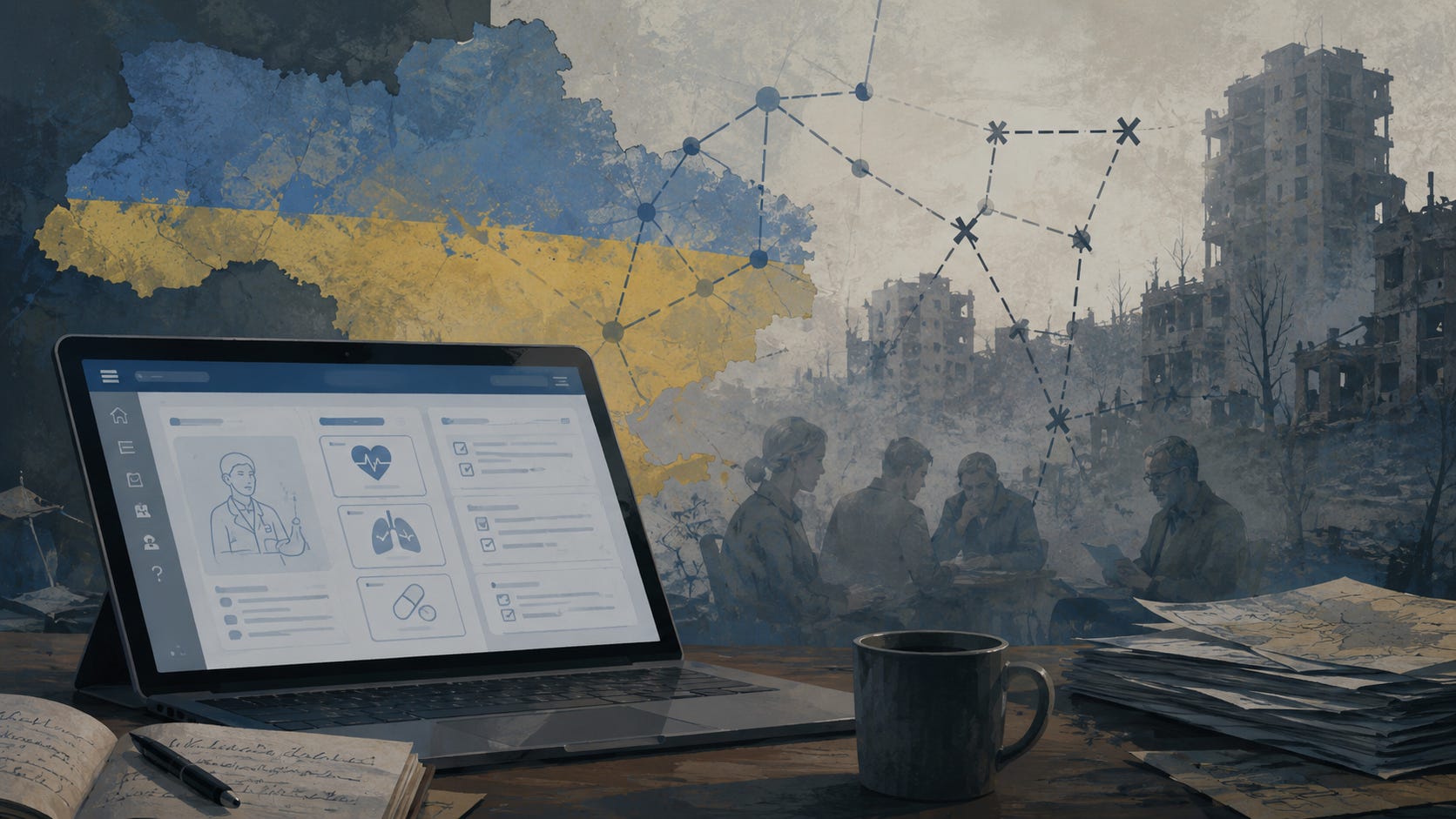
I led the development of the Ukraine Clinical Guidance website, and it failed.
Take yourself back to 2022: the tail of the pandemic and the unfolding crisis in eastern Europe. Across our screens came images of tanks, shelling and fighting across Ukraine. Within weeks the camera angles widened, and we saw attacks on hospitals, including the maternity hospital in Mariupol. Health workers were trying to keep services going while facilities, ambulances, supply chains and power systems were under attack or under strain.
A clinical guidance website felt practical. It could be built quickly, bring together trusted resources, translate useful material into Ukrainian and make it available to doctors, nurses and others working in disrupted conditions. It was not going to repair a damaged hospital, replace a missing colleague or reopen a supply route, but it seemed reasonable to think that clear guidance in the right language might help people practising in circumstances that were anything but normal.
The model was Myanmar. We had seen a similar approach work there after the 2021 coup, where health workers were also trying to sustain care under political violence, insecurity and institutional collapse. The Myanmar Clinical Guidance website I developed was never glamorous — a practical repository of clinical and nursing resources, forming part of wider virtual and blended support for people still trying to educate, supervise and practise in a fractured system.
In Myanmar, the website worked because it was not really just a website. It sat inside a network. There were relationships that pre-dated the crisis. Clinicians and educators knew each other, trusted each other and could say bluntly what was useful and what was not. There were people who could tell us whether a resource fitted practice, whether it needed translating, whether the format was wrong, or whether the best thing we could do was stop producing content and listen. The website had a route into practice because the relationships were already there.
That lesson should have been obvious: digital support works best when it is relational, specific and connected to people who can use it. I understood that in principle. I did not apply it well enough in Ukraine.
Ukraine looked similar only at the surface level — a country at war, health workers under pressure, clinical systems disrupted, an urgent need for practical support. That was enough to make the Myanmar model feel transferable. Emergencies create pressure to act quickly, and the digital answer has an obvious appeal: no travel, no visas, no security plan, no waiting for buildings to reopen. You can translate, upload and share.
But Ukraine was not Myanmar, which now sounds obvious. It had its own health system, professional networks, institutions, reform agenda, clinical culture, but my relationship with them was non-existent. We were left with having to try and launch from a standing start.
The Ukraine Clinical Guidance website was described publicly as a collaborative partnership containing clinical guidelines and resources for doctors, nurses and others in Ukraine . It included Ukrainian-translated clinical procedure videos and covered paediatrics, neonatal care, emergency care, obstetrics, nursing, mental health, surgery, general practice and first aid.
Over the three years it ran, barely anyone used it.
The resources existed, had been translated, and could be shared — but availability is a weak substitute for implementation. A clinical resource does not become part of practice because it has been uploaded; it becomes useful when people trust it, use it, adapt it and have some route to make it matter. A website can be live and still not be alive in the system. It can sit online, looking professional, without becoming part of anyone’s working day — without reaching the nurse in a cold ward, the doctor in another mass casualty episode, or the educator supporting students whose education has been disrupted by war.
What we learnt in Myanmar was that virtual resources travel through trust, repetition, ownership, adaptation, teaching, feedback and use. That was where we were weak in Ukraine. We had too many people involved, insufficient coordination, and no equivalent of the Myanmar network. There were good people around the work, but goodwill is not ownership, and it certainly missed the crucial convening layer between ourselves and clinicians. The website became one more well-intentioned offer in a crowded emergency information space.
That is not a satisfying failure, because nothing dramatic happened. The website did not collapse. It did not cause obvious harm. It did not become a scandal. It failed in the quieter way that global health programmes often fail: it existed, it looked plausible, and it did not become important enough to matter.
One reason this is worth writing is that global health is still not very good at talking honestly about failure. We are excellent at describing lessons learned once they have been made safe enough for a final report. We can say a programme was “challenging”, implementation was “complex”, engagement was “variable”, or the context was “fluid”. We are much less willing to say that something did not work — or that we copied the visible part of a model without copying the relationships that made it useful.
Polite language protects the wrong thing. It protects institutions, reputations and future funding bids, but it does not protect the next nurse, doctor, midwife or health worker asked to use a tool that has never really been tested in their context.
Ukraine is a good place to learn this, because the pressure on the health system leaves little room for romantic thinking about digital solutions. WHO has verified more than 3,000 attacks on health care in Ukraine since the full-scale invasion.
This matters for nursing. Nurses do not need another distant repository of things they might read if the shift ever calms down — they need usable support that connects with the decisions they are already making. A website can help, but only as part of a delivery route: with Ukrainian clinical ownership, a professional body or ministry partner, and educators and clinicians who request content, test it, and reject what does not work. It might also mean not building the website at all.
That is difficult for organisations to hear, because building something is satisfying. It gives everyone a task, and it can be announced and shared with language about solidarity. It lets institutions feel they have responded — and I understand the appeal, because I led exactly this kind of response. The problem is that emergencies reward visible action, while implementation looks slow, relational and dull. The slow work determines whether the visible action has any effect.
The network is often the crucial part of the model. Digital resources can be useful in war because they move faster than people can. They can cross borders, survive travel restrictions, be translated, updated and shared, and they can offer some support to clinicians cut off from ordinary teaching, supervision and professional contact. But they do not become useful simply because they exist.
If I were doing it again, I would start more slowly, even in an emergency. I would spend less time asking what we could build and more time asking who in the country wanted it, who would own it, who would reject content that did not fit, who would update it, who already had the trust of clinicians — in short, building a network. I would build less and listen more, and I would be much more suspicious of any solution that can be completed before the relationships exist.
That is not a comfortable lesson. It is not the sort of thing that looks good in a funding report. But it is probably the right one.