

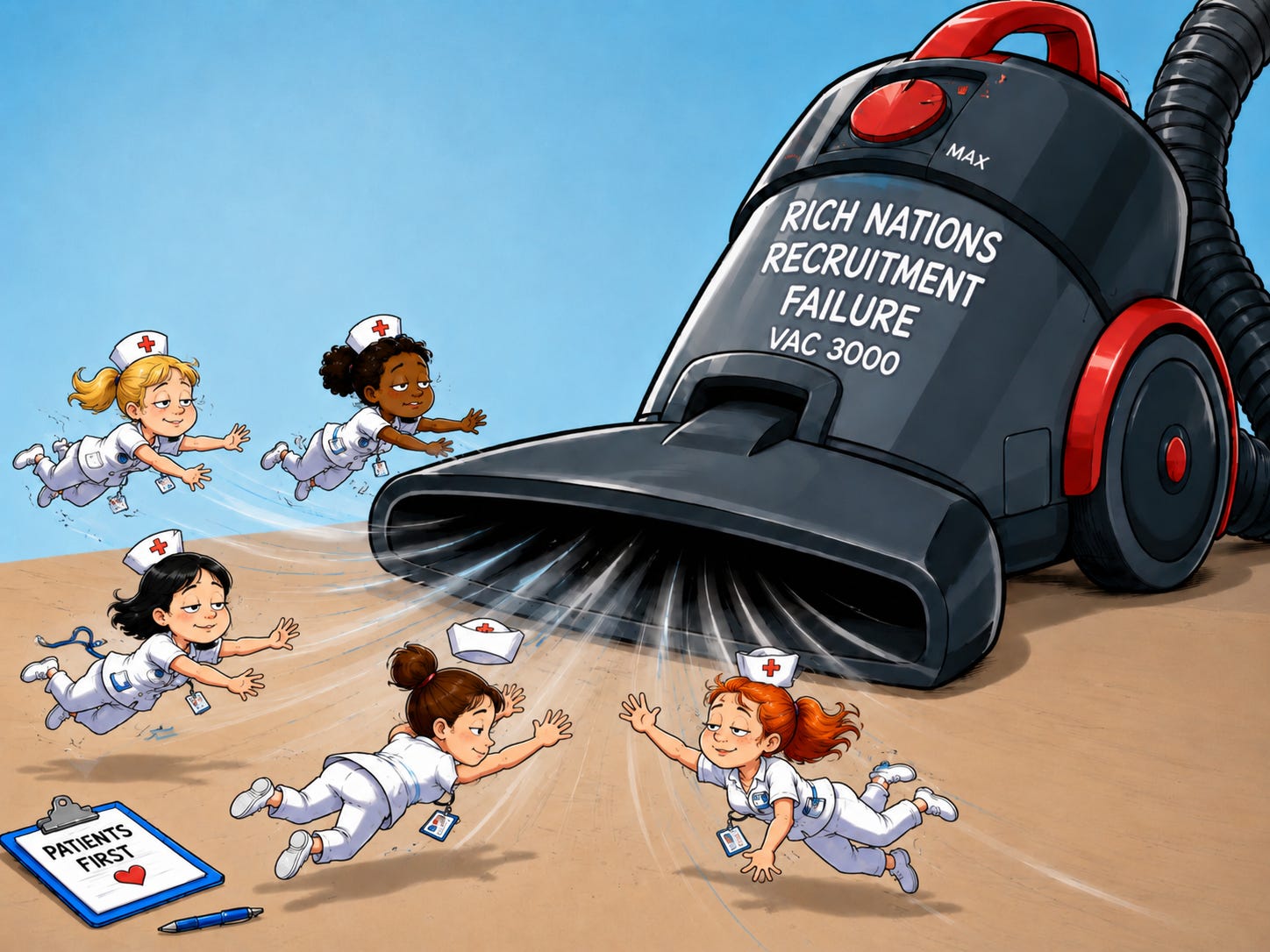
International Nurses Day is meant to make nursing visible. It often does this through familiar language about gratitude, contribution, and skill; a word salad of positive vibes.
Look at almost any social media post about nursing, and you will see pictures of diverse nursing teams, often with specific reference to the global nature of the workforce. This did not happen overnight and it did not happen by accident.
Wealthy health systems have relied on internationally educated and experienced nurses for years, often while speaking warmly about partnership with the countries those nurses leave behind. Nurse migration can be good for individual nurses. It can also expose the utter failure of destination countries to educate and retain enough staff of their own.
In the UK, Health and Care Worker visas issued to nursing professionals fell from around 26,100 in 2022 to 1,777 in 2025, a fall of about 93%. The route that once brought more than 26,000 nursing professionals in a year is now producing fewer than 2,000.
The UK is one example of a wider pattern. High-income countries have treated international recruitment as a pressure valve for domestic workforce failure. When services were short, recruitment expanded. When migration became politically difficult, the route narrowed. The result is nurses left in limbo, source countries unable to employ all the staff they have trained, and destination countries behaving as though workforce supply can be switched on and off.
Ghana shows why rich nations switching the vacuum off and on again is so bad for everyone. In 2025, Ghana’s Ministry of Health confirmed that more than 100,000 trained health professionals were unemployed, including nurses and other licensed staff, largely due to insufficient financial resources for employment. At the same time, Ghana remains a country with serious health workforce pressures, and its government has explored managed migration agreements with countries including the UK, the US, Jamaica, and Barbados, but that clearly isn’t going to work overnight. In the meantime, a globe with a nursing shortage has thousands of degree-qualified nurses making cappuccinos.
That is the damage caused by the current model. A country may decide to expand nurse training because it has real health workforce shortages, because students see nursing as a route into secure work, and because overseas recruitment has made nursing education appear to be a viable investment for the country. The country may educate nurses to meet long-term workforce needs, replace staff lost to migration, or expand access to care.
Why would they do this if they weren’t sure they could employ them?
Bluntly, because we live in an age of short-term governmental thinking and because education programs are often easier to fund and politically easier to announce than recurrent salaries, funded posts, and functioning long-term workforce planning systems.
This represents the arrival of a problem that seemed very far away, when, in many cases, a previous administration decided to open the tap on nursing education without a plan for where all the water would go, but with clear assurances that richer nations would employ a sizable proportion.
But when the destination-country route narrows, often through horrible immigration ‘island of strangers’ type narratives, the individual nurse is left between two failures: no funded job at home and no stable route abroad.
The Philippines has lived with a version of this problem for decades. It has trained nurses for a global market, and many Filipino nurses have built careers in destination countries. Their movement has brought income, professional opportunities, and remittances. It has also made the Philippines central to rich-country workforce planning in a way that should make those countries stop and think, what happens when we treat three and four-year nursing education programmes as a vacuum we can turn off and on.
The Nursing and Midwifery Council has reported this vacuum-on, vacuum-off effect in its numbers. In December 2025, it said growth of the register had slowed significantly because of a sharp fall in international recruitment. During the April to September periods from 2021 to 2024, international joiners made up around half of new recruitment to the register. From April to September 2025, they made up 25.8%.
Canada is working through a version of the same problem. Its federal government says the health workforce has faced shortages for some time and has invested in faster integration of internationally educated health professionals. That may be sensible policy if you are Canada’s Ministry of Health but also shows how quickly wealthy systems reach for overseas-trained staff when domestic supply falls short. The vacuum that was off is now on again.
Australia tells a similar story. The government has been developing a National Nursing Workforce Strategy, using modelling to understand workforce supply and demand over the next 12 years. At the same time, registration reform has created a faster route for internationally qualified nurses from comparable countries.7 Workforce strategy sits beside accelerated international recruitment because services need staff now.
Nursing is a global profession. The point is not that the UK, Canada or Australia should stop recruiting internationally. The point is that this model becomes fragile when wealthy systems assume the global workforce will keep absorbing their planning failures. Destination countries should also pay properly towards the education systems that produce the nurses they recruit (more on that in another post)
Put at its most basic, why should the people of, to pluck an example, Uganda pay to educate nurses whose clinical careers may then benefit the UK/Canada/Australia, when we screwed up our workforce planning?
WHO’s State of the World’s Nursing 2025 report says the global nursing workforce grew from 27.9 million in 2018 to 29.8 million in 2023, while distribution remains deeply unequal. The same report projects a global shortage of 4.1 million nurses by 2030 if current trends continue.
Those numbers should sit uneasily beside any simple claim that high-income countries are merely filling their own gaps. The world does not have a spare nursing workforce waiting at the airport when rich countries get a bit short. It has nurses making choices inside unequal systems. These are choices that the vast majority of us would make if we were in similar circumstances.
The ethical argument is often handled as if a code can tidy it away - ‘we don’t actively recruit from Red List countries’ is, frankly, doublespeak.
Responsible recruitment codes matter; do not remove the central problem: a high-income country that fails to plan and turns its global recruitment vacuum on and off haphazardly causes damage far beyond its borders.
That is hard to square with the language of gratitude when it looks a lot more like asset stripping. No amount of International Nurses Day messaging fixes that.
That is a very interesting journal truly thought-provoking. Thank you so much, Marcus, for bringing all of this together and drawing attention to these critical issues.
This is exactly what I have been reflecting on: why isn’t International Nurses Day used as a moment not just to celebrate but to shine a light on the gaps, the suffering, and the voices of nurses on the ground?
In Sudan, we are facing a very similar situation. We now have more than 100 nursing colleges, many of them private institutions, expanding rapidly. Nursing has become a profession that promises employment after graduation, which has attracted many students and families.
However, despite this growth, we are still facing a massive workforce gap. According to the latest statistics, around 12,000 nurses have been recruited by the government, while the actual need exceeds 80,000. This highlights a failure of more than 80% in meeting the country’s nursing workforce demands.
Since the war erupted, the situation has worsened significantly. Many nurses have been forced to leave the country, particularly to the Middle East, where they often face exploitation. Because Sudan is in crisis, they are offered extremely low and unfair salaries, taking advantage of their urgent need to support their families whether those families are still inside Sudan or displaced elsewhere.