

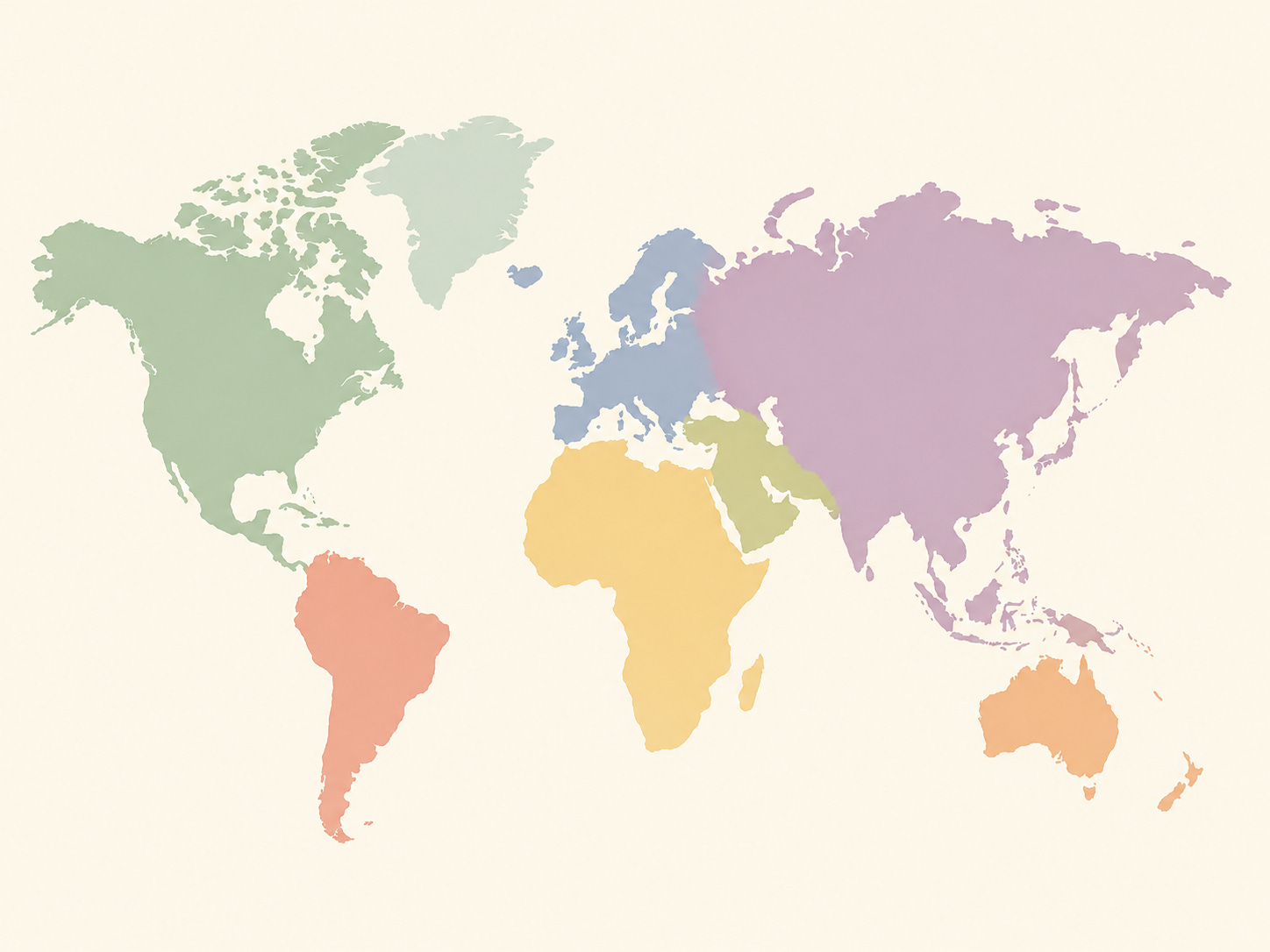
To be clear, there is no fully correct version of the world map. I am willing to concede that any two-dimensional representation of a three-dimensional globe will have to make some compromises.
The Mercator version, which adorns our schools, offices and homes, was designed largely for navigation and does an exceptionally bad job of showing the countries of the world as they really are. Mercator’s projection champions direction, but it severely distorts land area, especially the further you go from the equator.
Greenland can appear similar in size to Africa. In reality, Africa is around fourteen times larger.
If we can misread something as basic as the size of countries in our world, we should be careful about the other assumptions we carry into global health and nursing.
Global nursing has its own maps. They are less visible, but they shape how we think. They tell us where knowledge sits, where expertise comes from, where problems are located and where solutions are expected to begin.
These maps are often wrong too.
Much of global nursing still works from assumptions that are rarely examined. Some countries are treated as natural sources of expertise. Others are treated as sites of need. Some nurses are invited to teach, but others are invited to describe hardship.
Distorted assumptions sit inside curricula, conferences, funding models, authorship patterns and the language of international work. They sit inside words that sound reasonable: support, capacity building, technical assistance, partnership.
Capacity building is a useful example. The phrase often starts from a deficit assumption. It implies that capacity exists in one place and needs to be transferred somewhere else. Sometimes that may be true, but it is rarely the whole story. Sometimes it is simply wrong.
Nurses working in low-resource settings, crisis-affected systems, rural services, overcrowded hospitals or politically unstable environments often develop highly sophisticated forms of judgement, improvisation, leadership and professional discipline.
Their expertise may not always be written up in the journals we read. It may not sit inside the regulatory frameworks we recognise. It may not be described using the language of quality improvement, implementation science or systems strengthening.
That does not make it less important.
A distorted map can be very misleading in ways that go beyond the relative size of each country. It makes some places look larger than they are, and in doing so, it makes others look smaller.
The same thing happens in nursing.
If UK nurses are educated mainly through UK examples, UK regulatory assumptions, UK workforce debates and UK models of practice, familiarity can start to look like universality. We may know that nursing is practiced differently across the world. That is not the same as understanding it. It is certainly not the same as allowing it to change how we think.
Global nursing should therefore begin with more humility.
It requires us to notice when one part of the world is treated as the default and another as the variation. It requires us to ask who sets the agenda before we praise the partnership. It requires us to be more careful about what we think we know before we arrive.
Weak global understanding leads to weak global engagement.
For those of us in Europe we can easily overestimate what we can offer and then underestimate what we need to learn. Too many times, we design interventions and programmes around our own interpretation of what we think we see and then wonder why they do not sustain after we have gone.
We use the language of partnership while retaining control of the money, the agenda, the authorship and the microphone. Calling it a partnership does not make it so.
For global nursing, humility should be a professional discipline.
Before we teach, we should ask what we have failed to understand.
Before we build capacity, we should ask what capacity is already there.
Before we describe a problem, we should ask who has already defined it differently.
Before we claim a partnership, we should ask who holds power when decisions become difficult.
The world map most of us learned has shaped what we see.
Global nursing should care because the same is true of the professional maps of the assumptions we still use