

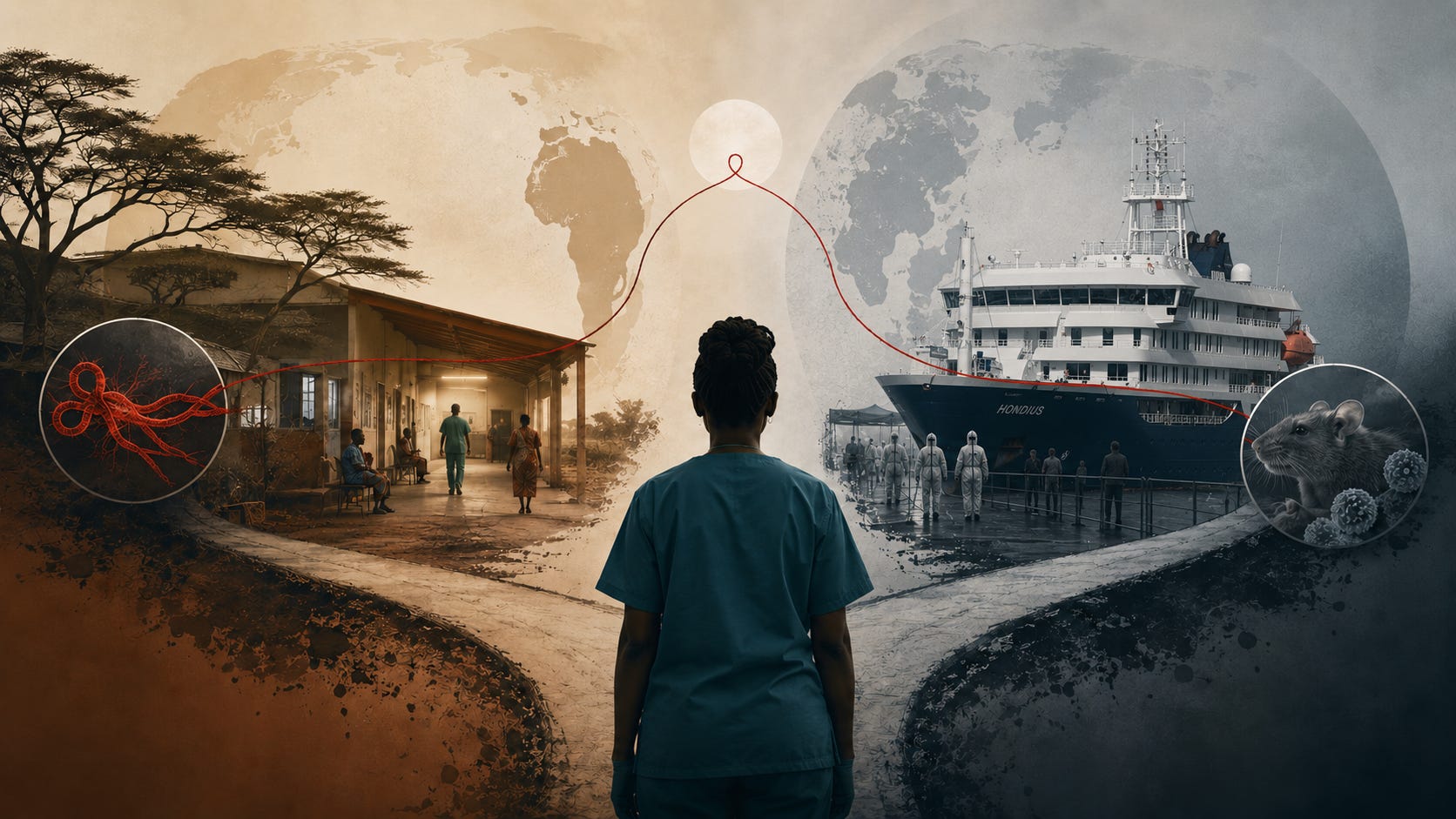
The phrase “emerging infection” can make an outbreak sound like a biological event first and a systems problem second. The two outbreaks that raced across our newsfeeds this week show something more.
In one setting, there is testing, quarantine, repatriation, monitoring, and a public health machinery that moves quickly. In another, health workers lack masks, transport, basic medicines and enough staff to keep services open, they are dying as a result. The virus matters, but the response is more clearly shaped by the system it lands in.
This week gives us two very different examples.
In the Democratic Republic of the Congo and Uganda, the WHO has declared an Ebola disease outbreak caused by Bundibugyo virus (Also known as Ebola) a Public Health Emergency of International Concern. WHO was alerted on 5 May 2026 to a high-mortality illness in Mongbwalu Health Zone in Ituri Province, DRC. The outbreak includes deaths among health workers, and the WHO has specifically noted that the infection and death of four healthcare workers within four days at Mongbwalu General Referral Hospital point to serious infection prevention and control breaches.[
At the same time, a hantavirus cluster linked to the MV Hondius cruise ship has produced a very different public health response: laboratory investigation, contact monitoring, quarantine, repatriation arrangements and international coordination across several countries. WHO reported severe respiratory illness cases aboard the ship in early May, with testing confirming Andes virus infection. The CDC later confirmed that 18 recently repatriated US passengers had been asked to remain at the Nebraska Quarantine Facility until 31 May 2026, the 21-day mark of their monitoring period.
The temptation is to write about these as two scary viruses, but Ebola and hantavirus are not the same problem. Ebola spreads through direct contact with the blood or body fluids of symptomatic patients and has a long history of transmission in health facilities. The Andes virus (hantavirus) is unusual because person-to-person transmission is rare. However, the wider public health risk in the current cruise ship outbreak has been described by WHO as low.
One outbreak is unfolding in conflict-affected central Africa, where responders are dealing with deaths among health workers, uncertain spread and shortages of basic supplies. The other is linked to a cruise ship, where passengers can be traced, repatriated and monitored through formal systems with a level of logistical capacity that most outbreak responses can only envy.
Reuters reported that first responders in the DRC were short of basic supplies, including pain medicine, masks, and motorbikes for contact tracing. Without wishing to state the obvious, a contact tracer without transport is not a contact tracer in any useful sense.
A nurse without protective equipment is at an exceptionally high risk. A facility without basic infection prevention is not simply under-resourced; it can become part of the chain of transmission. The damage beyond those suspected of having the virus and the delays in care can be colossal.
In outbreaks, nurses are not a decorative part of the response. They are usually the people closest to the risk - Triaging the fever, liaising with close contacts, and cleaning up infectious body fluids.
When health workers die early in an outbreak, it is not only a personal tragedy; it is a screaming warning about the system. It tells us something about training, supervision, protective equipment, water and sanitation, triage, isolation, staffing and trust.
The hantavirus outbreak on the cruise ship shows another side of outbreak management. Here, the issue is less about the collapse of basic infection prevention and more about public health logistics. Who was exposed? Who needs monitoring? Who can travel? Where can people be safely quarantined? Who explains the risk without turning uncertainty into a macabre theatre?
To move away from the more sensationalist to, for me, the central question - why some outbreak responses have transport, testing, quarantine capacity and international coordination, while others are still asking for masks and motorbikes?
We are very good at saying that pathogens do not respect borders. We are less good at admitting that outbreak response capacity is profoundly affected by the places immediately at risk, the countries where it is detected, and often, the nationalities of the people it kills.
A cruise ship outbreak involving international passengers triggers a certain machinery. An outbreak in a conflict-affected health zone in the DRC triggers another, slower and far less effective one.
That does not mean wealthy countries should ignore imported risk and wait until an outbreak becomes their problem. It should mean the opposite, if the world wants early containment, it has to fund the basic infrastructure that makes it possible. Surveillance does not begin with a dashboard in Geneva.
It begins with a nurse who spots a symptom or a pattern among patients, a laboratory that can process a sample, a vehicle that can reach a village, a facility that can safely isolate, and a workforce that trusts it will not be left to cope with the pathogen unprotected.
The Global Preparedness Monitoring Board has again warned that preparedness reforms have not kept up with pandemic risk.
Nursing has a dog in this race because outbreak response relies on forms of work that are often poorly valued until they fail. Infection prevention is not glamorous. Triage is not glamorous. Cleaning, waste disposal, donning and doffing, explaining isolation, monitoring contacts, and maintaining records do not gain world attention in the way a scary, uncontrollable virus does.
Ebola has taught this repeatedly. Health facilities can save lives, but they can also amplify transmission if the basics are missing. That is not a criticism of individual nurses. It is the predictable consequence of asking staff to manage high-risk care without the conditions required to do it safely.
Hantavirus teaches a different lesson: when we really want to do outbreak control properly, we can. Still, good quality nursing, from the first nurse on the cruise ship all the way along the chain, is essential and demands effective funding.
The danger is that we talk about nurses in outbreaks only when they become symbols: brave nurse, fallen nurse, heroic nurse in PPE. It’s not difficult to see why, but it would seem preferable to focus on what would have kept the nurse safer before bravery became necessary.