

I am cycling from London to Brighton to raise money for LSHTM’s scholarship fund. I don’t charge for my articles, so please sponsor me if you can by clicking below
I had my blood pressure taken this week as part of an over-40s health check. I could spend the rest of this week’s post bemoaning my seemingly rapid rush through middle age; however, growing old is a privilege, as I have to keep telling myself.
As I’m apt to do, let’s start with the obvious: the outcome of having a blood pressure check depends on far more than the competence of the health worker undertaking the clinical assessment.
Let’s assume the numbers are slightly off (thankfully, mine were fine) and medication, referral, or follow-up is required; it’s at this point that, in thousands of health settings worldwide, the problems start.
The required antihypertensive is out of stock for the next month, the notes have disappeared, the laboratory test is unavailable, the next specialist appointment is six months away, or perhaps not a viable option at all.
Patient safety narratives seem built around clinical performance, which ignores the fact that even the best nurse can’t provide safe care in an unsafe system. WHO recognise this by stating most harmful errors arise from system and process failures rather than the actions of individual health workers.
For many of us, clinical or otherwise, we view patient safety through the prism of acts or omissions. We often understand it through events during a clinical encounter, such as the wrong dose, a missed diagnosis, or a poor handover. Even in education, patient safety and system failures are often pinned on individuals, teams, or sometimes the nebulously mythical category of ‘managers’.
I wonder whether we should look at this differently?
A clinically indicated medicine that is unavailable can also harm a patient. The same applies to a referral pathway that exists on paper but cannot be accessed. There is a coherent argument that unreliable health-system infrastructure should itself be treated as a patient-safety problem.
The ‘problem’ is that patient safety ceases to be a soley individual issue: ‘the nurse screwed something up, which caused the poor outcome for patient X’. It becomes one that arrives more forcefully at a politician’s door: ‘the patient did not receive optimal treatment for their hypertension because of a failure over the past decade to invest enough of the nation’s health budget in robust supply chains’. That is far less forgiving of the architecture which surrounds the nurse, and it’s also arguably more accurate.
The management of uncomplicated hypertension within the community is clinically relatively straightforward. We have fairly well-established guidance for health workers; as with many conditions, global agreement is broad on the principles. Guidance requires a nurse to measure blood pressure accurately, assess cardiovascular risk (we even have a broadly agreed list outlining the ‘risk’), begin or adjust treatment, then monitor the response and arrange follow-up.
All of which can be done by a suitably qualified health worker, can’t it?
In a word, no.
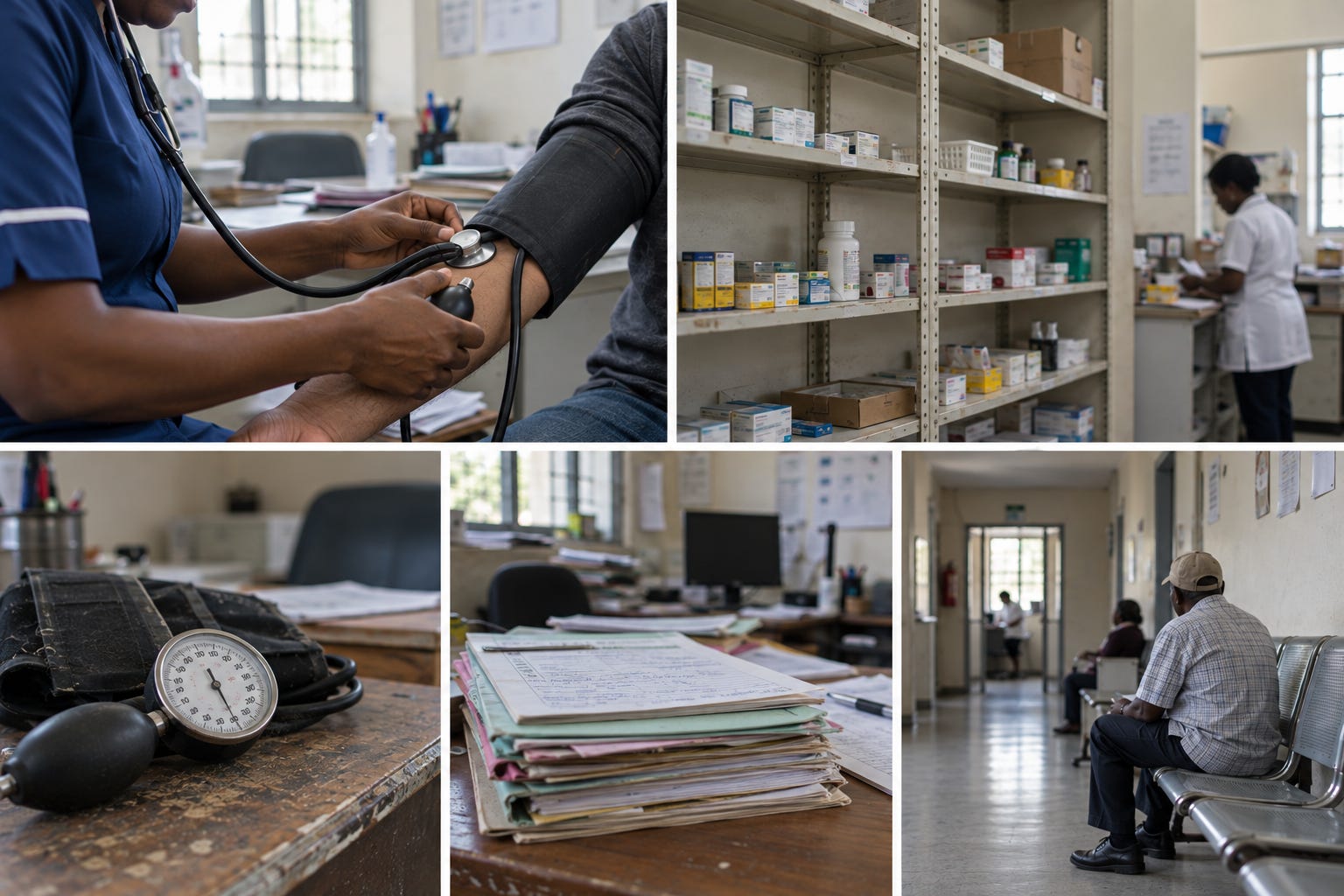
Accurate diagnosis requires a validated blood-pressure device that is available, the correct cuff size, and routine maintenance and calibration. It also requires the nurse to have enough time and space to repeat the measurement properly (if required) rather than relying on a single hurried reading.
Safe prescribing means a nurse has access to the patient’s clinical history, current medicines and relevant diagnostic tests. Without reliable records or laboratory capacity, the nurse is likely to be unable to identify contraindications, interactions, renal impairment or previous adverse effects and may end up making educated guesses.
Starting treatment relies on the availability and long-term affordability of medicine, which is crucial in many long-term conditions.
An appropriate prescription offers little safety if the pharmacy is out of stock, the available formulation changes, or another unforeseen problem arises that is invisible when the prescription is signed.
Referral guidance only works if the service is available, will accept the patient and can be reached. The referral might be safe in principle but practically unusable because of distance, cost, transport, waiting times or conflict.
Follow-up relies on a complex (probably computerised) system that records appointments, reminds patients to return, and flags missed appointments.
The apparent simplicity of the pathway therefore conceals a chain of dependencies that extends in every direction from the nurse in the clinic checking my blood pressure.
Failure at any point in this long chain of dependencies, which often stretches across borders and countries, can expose the patient to harm even when the nurse has followed the guidance impeccably. The interaction is still unsafe despite the excellent nurse, rather than because of them.
In my view, most members of the public do not see these small system failures more often because health workers across the globe can bend, flex, and adapt to the circumstances around them in astonishing ways.
Every day, we absorb system unreliability by improvising follow-up, finding substitutes, reconstructing histories from patients themselves, negotiating referrals, explaining why promised care has not materialised and conjuring up (sometimes from thin air) a viable alternative.
At this point, it is important to distinguish between individualised care, sound clinical judgement, and forced workarounds that create fresh opportunities for error.
It is easy to be judged for poor outcomes against a standard of care whose prerequisites were unavailable, forcing a level of improvisation.
Given all this, it’s no surprise that there is a link between care quality in hypertension and system strength. The World Health Organization’s 2025 hypertension report found that only 28% of low-income countries reported general availability of all WHO-recommended hypertension medicines, compared with 93% of high-income countries
No surprise then that the WHO estimates that 1.4 billion adults aged 30–79 had hypertension in 2024 and only about 23% had it controlled; two-thirds of those affected live in low- and middle-income countries.
These figures reflect missed diagnosis, suboptimal clinical care and the wider system failures described above.
As with so many of the world’s failings, by not treating these non-complex patients now, we are solving little and storing up avoidable strokes, heart attacks and Alzheimer’s for decades to come.
This is doing us, and those who follow, no favours
We are filling a cold ocean with icebergs of complications and complex patients for the next generation of nurses to navigate for decades.