

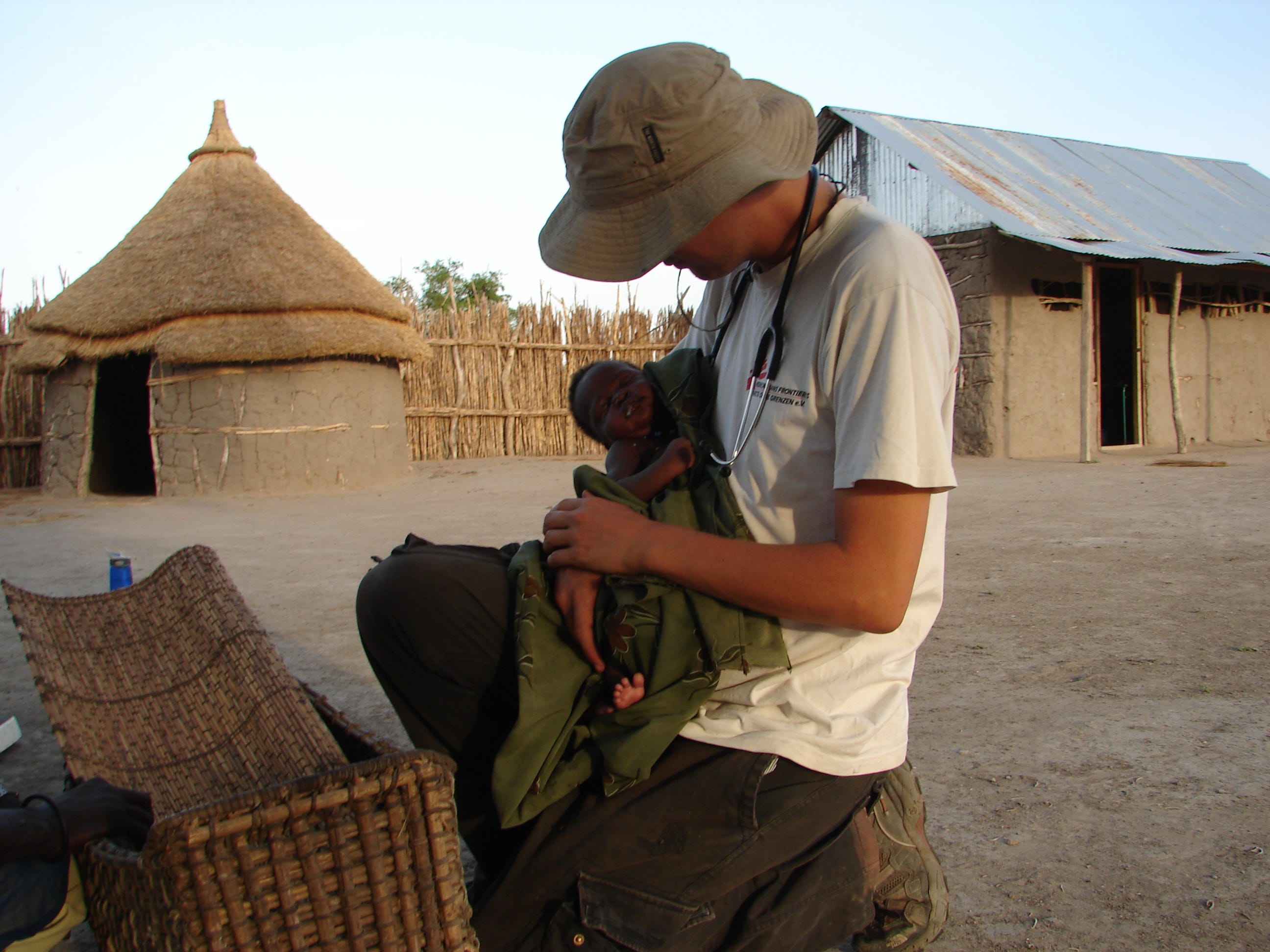
Twenty years ago this week I sat in my parents’ house in the leafy suburbs, two-thirds excited and one-third terrified, and started a blog. The next morning I flew to a country I wasn’t allowed to name (Jonglei state, Southern Sudan; the war made discretion sensible) and spent a year there as an outreach nurse, writing it all down by head torch. I was 25 and couldn’t really have told you what the job was had you asked me. Neither, it turned out, could the job description.
I found the blog recently, sitting inside an abandoned hollow of the internet.
First off, the title is really problematic; I broad-brushed ‘Africa‘ when I could have been more imaginative and respectful of a continent I am so privileged to have visited many times.
It’s the sort of thing I tell my students off for doing now. It was naivety at its grandest form, and I wince a bit now when I think of it.
Reading it two decades on is odd, and what has spooked me a bit is that nearly everything I now say for a living, in journals and on conference stages, I had already written by Christmas 2006.
At age 25 I described the clinics I worked in as “islands of treatment in an ocean of nothing”. Within weeks I had worked out that the foreign aid worker is “much overrated in many ways we are a nice optional extra”, and that the national staff who kept looted clinics open through a war were doing the real work: “sadly you don’t see movies about them”. I watched an American doctor land, assess one child for a disease she turned out not to have, and fly off again past a crowd of unimmunised children, and I did the sums on what her plane had cost.
I wrote about a village three hours’ walk from clean water and the swamp its people drank from, the same swamp they used as a toilet. I noticed that our clinic was treating diarrhoea with medicine the patients washed down with the water that had given them the diarrhoea in the first place. When the village’s hand-operated water pump broke, I could date it from the clinic records. Gastroenteritis was up 67 per cent within three days.
I have spent much of the past two decades saying slightly more sophisticated versions of the same things I wrote in the blog: history doesn’t repeat, but it often rhymes, as Twain said.
The evidence base I lean on now has improved enormously, but many of the observations haven’t changed at all.
It would also be lazy and overly negative to suggest that progress has not been made in the time since I left Sudan.
The world I was writing about killed a child with measles every few hours, and that has genuinely changed. Global measles deaths fell from roughly 780,000 in 2000 to around 107,500 by 2023 . Under-five mortality has roughly halved over the same period. The meningitis A vaccine I once nursed through a failing cold chain (cool boxes cosseted, as I put it then, “like vintage bottles of wine or champion race horses”) was replaced a few years later by MenAfriVac, which has all but ended epidemic meningitis A across the belt where I worked. When we vaccinated 7,758 people in a week and lost none of the nearly fifty meningitis cases our clinic saw, I was, without knowing it, working at the tail end of a problem that was about to be solved for good. So the machinery of international aid can work. Money and attention, held on a single problem long enough, will fix it.
There is almost no media attention on this astonishing progress; you would find it a challenge to find anyone who doesn’t work in our industry who knows about it.
However, progress in other areas is far less impressive and in places it’s hard to see any improvement at all.
When I was in South Sudan, there was a Comprehensive Peace Agreement in place, which was notable because the peace was limited, the agreement often far from certain, and it could never be described as comprehensive.
The death of the key political leader John Garang in a mysterious helicopter crash in 2005 had made South Sudan yet more unstable, and I still remember even now the various incidents when the war came very close indeed.
Southern Sudan was five years from independence when I arrived, and, despite the challenges I wrote at the end, hopefully about “a country supposed to be grabbing the opportunity of peace with both hands”. Sadly, that didn’t go as I wished, and plenty of those villages still have no pump. The islands of treatment are still islands. We have simply spent twenty years mapping the ocean of limited healthcare in higher resolution.
This February a plane dropped a bomb on Lankien. The hospital in Jonglei where I had worked had run continuously since 1995 and was the only advanced healthcare facility for a quarter of a million people; the compound of huts and the airstrip I flew in and out of are recognisable in the blog. Staff discharged their patients in the hours before the strike, having had warning; some of them were women in labour. The bomb hit the warehouse, the town was taken and looted, and in April MSF announced that after thirty-one years it was closing Lankien for good.
It is the fourth of its hospitals in the country shut by attacks since the start of 2025. MSF will only say that government forces are the sole party with the means to bomb from the air; local investigators have reached less guarded conclusions.
Twenty years ago I helped rebuild clinics that had been stripped bare in exactly this way, and I wrote then that the work was the work of a generation. How tragic that I have turned out to be right.
What would really bewilder the 2006 version of me is who I’ve become. I was scathing then, in an amateur way, about some of the machinery of aid. My entry on data collection calls it “spirit crushingly dull” and admits that six hours of work had achieved nothing except that “the Excel columns are now in different colours”. I wrote whole paragraphs about reports nobody would read, while a clinic full of patients waited outside.
My life now is often spent trying to find and support data collection across the various programmes I support. I didn’t realise then that the healthcare deserts mapped closely to the data ones.
There were some other parts on data that I had completely forgotten. I reread a blog post I had written about an afternoon spent completing government tax forms for staff who did not know their dates of birth, and yet the form required one, so we found ourselves in a quandary.
The only way out? Fraud.
So we built them together: what year were you married? Let’s say you were twenty then (year of birth) . Pick a number between one and twelve (month of birth) and (my favourite) how many cooking pots do you have at home? (Day of birth). Thus quite a few people were born on the fourth of July!
I committed that fraud upwards of thirty times, and it remains the most complete description of what happens when bureaucracy designed in one world lands on another that I have ever produced.
Nothing I have written since, with a reference list attached, has said it better. The same goes for the shop I passed one Sunday selling pillowcases, pocket mirrors and intravenous gentamicin. South Sudan’s entire health system summarised in a sentence.
I ended the final entry, somewhere over the Mediterranean, with the only line in ten months I didn’t undercut with a joke: but for an accident of birth, it could be you or me there. Twenty years on, the accident of birth still decides who nurses and who is nursed, and whose clinic is safe.
The blog’s most obvious finding was the one about us: the foreign aid worker as a nice optional extra. I have spent twenty years testing that hypothesis with my own career, and I would say that, broadly, it holds. Certainly we should focus on the nurses who are working to develop services in their own countries and give far less press attention to the foreign aid worker. I often hear it said that UK audiences won’t focus on a story unless there is a UK angle. I think this grossly underestimates the audience.
The people who were essential in 2006 were the national staff who reopened looted clinics, and the people who are essential now are those who continue to care for the people of Jonglei.
The Hull-Mbarara partnership was working really well in 2000+. We were dismissive of THET's request fot data as we were working and teaching on the wards. By the time we were persuaded to collect data the seed funding had been spent and the dedicated individuals who carried on the link didn't collect data. So we are left with photos but no facts.