

London has already had its first warning shot of the summer.
In late May, the UK Health Security Agency issued its first amber heat-health alert of 2026, covering London and other parts of England, warning that high temperatures could put vulnerable people at increased risk and that health and social care services needed to prepare. The heat then broke records. Temperatures reached 35.1°C at Heathrow and Kew Gardens, the highest May temperature recorded in the UK.
The media, as ever, reported the whole thing with pictures of young people enjoying the sun and people eating ice creams.
Heat waves such as this are lethal.
The emerging El Nino patterns make an urgent issue much worse
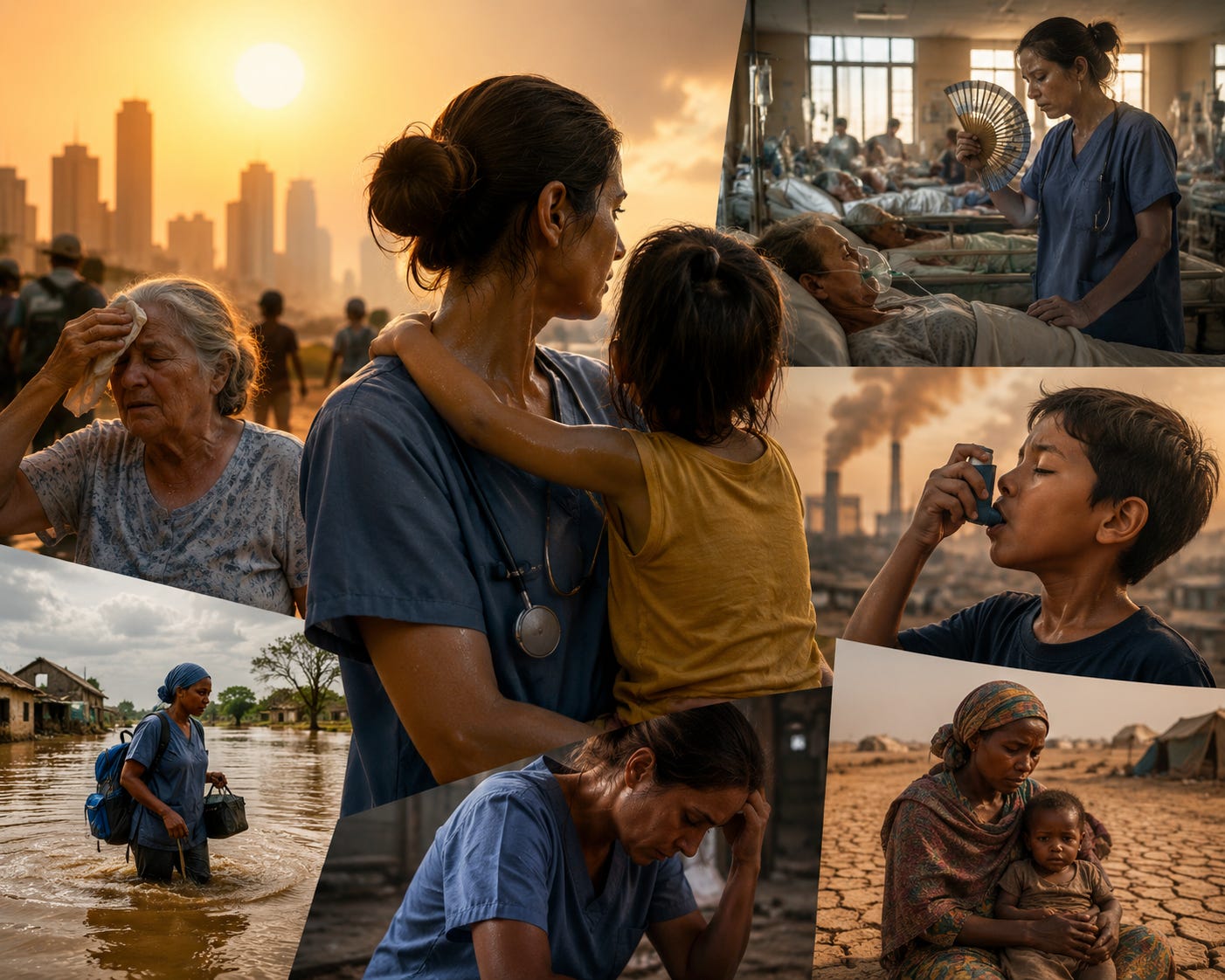
As older people suffer in flats that do not cool down, children’s asthma worsens in hot and polluted air, care homes try to keep residents hydrated, and nurses toil in hospital buildings designed for another climate.
The UK does have a plan for this. The UKHSA Adverse Weather and Health Plan sets out how health and social care, local government, voluntary organisations and communities should prepare for weather-related harm. It is sensible enough as a document, but talking is one thing; walking is quite another.
Much of that ‘walking’ workload will land on nurses.
Climate change is now routinely described as a health emergency, and that is right, although the phrase can still sit rather comfortably above the more awkward practical question of who is expected to notice, absorb and respond to the consequences. In ordinary clinical life, the response begins with someone recognising the heat-exhausted patient before they deteriorate, someone keeping an eye on the older person who lives alone through three hot nights in a flat that does not cool down, and someone noticing that a child’s breathing has worsened because the air outside has worsened too.
In most health systems, that someone is often a nurse.
WHO describes climate change as a threat to the basic conditions for health: clean air, safe drinking water, food and shelter. That is useful because it keeps the issue out of the abstract. Climate change does not only create new problems. It makes old problems harder to manage, and it presses on the bits of the system that were already weak.
Heat makes this obvious. WHO’s heat and health guidance says heatwaves and prolonged excess heat are increasing because of climate change, and that even low and moderate heatwaves can affect vulnerable people. That sounds simple until you imagine the actual shift required.
The UK has already had a small taste of what this means in practice, even if we are still inclined to treat it as an unusual inconvenience rather than a predictable pressure on health services. Older buildings overheat, hospital wards become uncomfortable and sometimes unsafe, and staff respond in the way health workers usually respond when the system has not caught up: they improvise with fans, fluids, ice, opened windows, closed blinds and a fair amount of common sense.
That is something, and it may prevent harm in the moment, although it should not be mistaken for adaptation. It is people making do inside infrastructure built for a climate that no longer quite exists.
In lower-resource settings, the margin is thinner because heat may arrive where clinics already lack reliable electricity, flooding may arrive where roads are already fragile, and drought may arrive where malnutrition is already part of the clinical picture. Climate risk rarely arrives as a neat, single hazard that can be managed in isolation; it tends to turn up alongside the existing failures in housing, transport, staffing, water, food security and access to care, which is why the burden falls so quickly on the people trying to keep services working.
This is why climate health planning has to move beyond risk registers and tidy lists of hazards. A plan that identifies heat, flooding and disease risks is only half useful unless it is equally clear about the workforce expected to respond when those risks become patients, families and disrupted services. Someone has to visit the isolated older person, triage the breathless child, explain to families what deterioration looks like, maintain routine care while emergency work expands, and keep enough of the ordinary health system functioning so that the climate response does not simply consume everything else.
If the answer is “the existing workforce”, then the plan needs to admit what that means.
Nurses already hold together parts of health systems that do not quite work. In many countries they are the most accessible professional group, especially in rural and community settings. They are also the workforce most likely to see the early signs that climate pressure is becoming clinical risk. Heat stress, dehydration, diarrhoeal illness after flooding, missed medicines after displacement, worsening asthma, maternal risk, mental distress after repeated shocks.
The health of Children should make this harder to ignore. UNICEF describes climate change as a major threat to children’s health, nutrition, education, development and survival. Children are less able than adults to withstand extreme weather and are more vulnerable to temperature changes and disease.
That language is grant, but the consequences are ordinary enough to recognise: a child missing school after displacement, a baby with diarrhoea after contaminated water, a teenager anxious after another flood, a child with asthma breathing hotter and dirtier air.
These are not only paediatric problems. They become family problems, school problems, community problems and nursing problems.
Global nursing needs to say this more clearly because climate adaptation is not only about greener hospitals, although health care emissions matter. Adaptation is also about whether nurses are educated, staffed and supported to deliver care in a changing climate. A carbon plan without a workforce plan is useless.
This is where global health language becomes slippery. We talk about resilient systems as if resilience is something that can be written into a strategy. In practice, resilience often means people absorbing more than they should. Nurses are told to adapt. Communities are told to cope. Facilities are told to prepare. Then the heatwave, flood or outbreak arrives, and the same thin workforce is expected to make the plan real, often from a standing start.
I am not against plans. I have seen enough chaos to appreciate a decent one. The problem is the gap between a plan and the conditions needed to deliver it. A climate health plan that does not reach the rota, the curriculum, the placement, the medicine supply chain, then it is worthless.
Nursing education has to catch up with this as it is clear climate change cannot sit as a decorative lecture somewhere near the end of a public health module. It needs to be woven into the practical formation of nurses. What does heat illness look like in an older adult? How does flooding change infection risk? What happens to long-term medication when families are displaced? What does safe care look like when a clinic loses power?
Many years ago I worked in South Sudan and watched as carefully applied wound dressings washed away as the population walked home from the clinic through a series of knee-deep rivers, without the tools to adapt; I fear our efforts were often undone by the water that surrounded us.
There is also a leadership issue. Nurses are often close enough to see what is changing, but not always powerful enough to shape the response, hardly unique to this topic. The people who understand the practical system are consulted late, asked to implement quickly, and then blamed if reality refuses to match the plan.
Climate adaptation will fail if nurses are treated only as delivery staff. They need to be involved in risk mapping, service design, education planning, emergency preparedness and community communication. That is not because nurses are morally better than anyone else. It is because they know where the plan on paper will fall apart in reality.
In conflict-affected and fragile settings, climate risk does not wait politely behind political crisis. Floods hit displaced populations. Heat affects people living in temporary shelters. Drought worsens malnutrition. Disease patterns shift while surveillance systems are already weak. Nursing staff are then expected to continue care with fewer supplies, less security and less support.
It is also the places facing the greatest climate health risks that are often not the places most responsible for creating them. They are also often the places with the least spare workforce capacity to respond. When global climate finance talks about health adaptation, nursing should be in the middle of the conversation.
That means investing in community nursing, public health nursing, emergency preparedness, infection prevention, mental health support, maternal and child health, and the education systems that produce nurses capable of working in more unstable conditions. It means protecting nurses during disasters and conflict.
It means designing facilities where staff and patients can survive heat.